How Brawl Stars' Drum Roll Mode Turns Every Knockout Into a New Brawler
Brawl Stars Drum Roll forces a new brawler after every knockout, pushing chaotic 7-elimination wins and daily Star Tokens toward returning Mega Boxes.
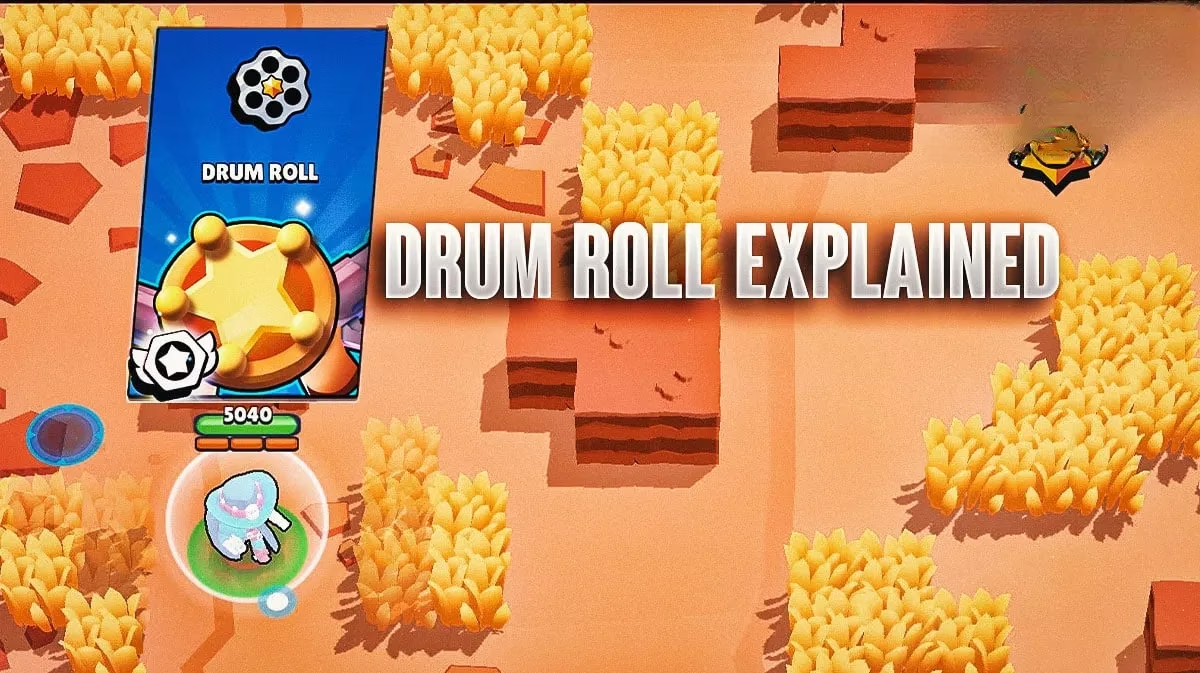
Juno had queued into Brawl Stars expecting a normal match, but the loading screen flashed something different: Drum Roll. It was the kind of mode that sounded straightforward—eliminate seven enemies—but the catch was enough to make even veteran players hesitate. Every single knockout morphed her into a completely different brawler. One second she was using Colt’s long-range shots, and the next she was slamming into the fight as El Primo. Talk about a curveball.
The Core Twist: Every KO Swaps Your Brawler
Unlike a standard free-for-all, Drum Roll isn't about sticking with a comfort pick. The objective is to eliminate seven enemies, but each time Juno secured a knockout, she didn't just gain progress—she changed character. The mode uses a predetermined brawler queue, meaning the order is fixed and can't be altered.
| Brawler Queue 1 | Brawler Queue 2 |
|---|---|
| Colt | Brock |
| Mortis | Nita |
| Dynamike | Jessie |
| Spike | Leon |
| El Primo | Piper |
| Poco | Pam |
| Frank | Bull |
Once a match starts, players are placed into one of these two queues. There's no picking favorites, and no changing the sequence. If you're on Queue 1, your path goes from Colt all the way to Frank. If you're on Queue 2, you start with Brock and finish with Bull. It forces everyone to adapt on the fly, and the tables can turn on a dime.
Level Rules and Limitations
Drum Roll strips brawler progression to a level playing field. All brawlers in the mode are set to level 9 and can only use their first Star Power. Gadgets? Not available. Hypercharge abilities? Not happening. Level 10 and level 11 brawlers are also out of the question.
Death works like a short reset. Players respawn after a few seconds, but every defeat on your end means another player has moved to the next stage. That creates a tug-of-war between caution and aggression. Play too safe, and someone else reaches seven eliminations first. Play too reckless, and you're feeding progress to the entire lobby. It’s a balancing act, plain and simple.
Star Tokens and the Return of Mega Boxes
One of the biggest reasons to jump into Drum Roll is the reward loop. There are no trophies to lose, but there are also no trophies to win. Instead, players can collect Star Tokens by playing Drum Roll daily. Gather enough Star Tokens, and a Mega Box appears.
Mega Boxes have made their return to Brawl Stars for limited-time Classic Event windows. The incentive is clear: the more modes you play, the more Star Tokens you can earn, and the more Mega Boxes you can open. Drum Roll is just one piece of that puzzle, but it's a fun one—especially since the pressure of trophy loss is completely removed.
Learning to Flow with the Queue
For Juno, the first match felt chaotic. She started as Colt, then suddenly became Mortis, a brawler with a completely different tempo. After a few rounds, though, she learned to stop fighting the rotation and start flowing with it. Knowing the order of brawlers meant she could predict what tool she'd have next and position accordingly. She took a breath and readied up again—after all, no trophies were on the line, so the only thing to lose was pride.
The beauty of Drum Roll is that it turns the usual Brawl Stars formula into something closer to an arms race. Every knockout is progress, but it's also transformation. Whether you're chasing Star Tokens, Mega Boxes, or just a break from ranked pressure, the mode rewards quick thinking and a willingness to embrace whatever brawler comes next.
This discussion is informed by coverage from Eurogamer, and it helps frame why Brawl Stars’ Drum Roll twist—forced brawler swaps after every KO—feels so refreshing: it pushes moment-to-moment adaptation over mastery of a single pick, similar to how limited-time modes in competitive games often reshuffle priorities from “perfect loadout” to “best decision right now.” In practice, the fixed brawler queues and capped loadouts (no gadgets, no hypercharge) make fundamentals like positioning, target selection, and timing matter more than build optimization, which is exactly why Drum Roll plays like a fast-moving skill check rather than a pure meta contest.
0 Comments