The Hollow Echo of Platform Fighters: When IP Worship Replaces Substance
The 2026 crossover fighting game landscape, exemplified by MultiVersus, reveals a crucial flaw: mistaking beloved IP recognition for the masterful gameplay mechanics that define the genre's true success.
In the year 2026, the landscape of crossover fighting games remains a curious spectacle, a stage where beloved intellectual properties dance to a tune they often fail to comprehend. The recent release of MultiVersus serves as a poignant reminder of this recurring phenomenon—a phenomenon where the shimmering veneer of familiar faces is mistaken for the soul of a great game. Like a stage magician whose entire act relies on a single, well-worn trick, these titles attempt to conjure excitement from recognition alone, forgetting that magic requires both illusion and genuine skill.
 .jpg)
.jpg)
We exist in an era of profound IP adoration, where the mere mention of a beloved universe can send ripples of anticipation through the digital ether. The Marvel Cinematic Universe stands as a colossus, a cultural singularity that bends lesser-known properties into its gravitational pull, granting them a borrowed luminosity. Fortnite has perfected the art of the weekly crossover, turning its island into a bustling, chaotic museum of modern pop culture. In this climate, the announcement of a new character joining the fray in Super Smash Bros. Ultimate feels like a global holiday. Yet, this celebration stems from a fundamental misunderstanding. The true heart of Smash does not beat because of its roster; it beats in spite of it. The IP is the glittering chandelier in the ballroom, but the foundation is the exquisite dance floor upon which everything moves. Imitators like Nick All-Star Brawl and now MultiVersus mistake the chandelier for the entire architecture of the house.
The success of the MCU was not a sudden explosion but a carefully cultivated garden, where audiences learned to expect a certain, reliable quality—a cinematic comfort food consistently served at a B+ grade or higher. The DCEU's stumble was a classic case of planting plastic flowers and expecting them to bloom, rushing to a team-up spectacle without first tending to the soil of individual character stories. Justice League asked for adoration based on pedigree alone, a request that revealed the limits of our fandom: we may worship the pantheon, but we only truly connect with the gods we have come to know. This lesson echoes loudly in the arena of platform fighters.
Super Smash Bros. Ultimate is, at its core, a masterfully crafted system of movement, impact, and strategy. Whether one labels it a fighting game or a party game is semantics; its excellence is undeniable. The thrill of pitting Cloud Strife against Kirby is not inherent. It is a potential energy that requires the kinetic spark of superb gameplay to ignite. If the underlying mechanics were a rickety stage, the spectacle of Sora dueling Joker would be as meaningful as two famous portraits being tapped gently together; the potential for drama exists, but the medium fails to convey it. This is the hollow core that recent clones have, perplexingly, chosen to emulate—like building a cathedral that meticulously copies the stained glass but forgets to pour the foundation.
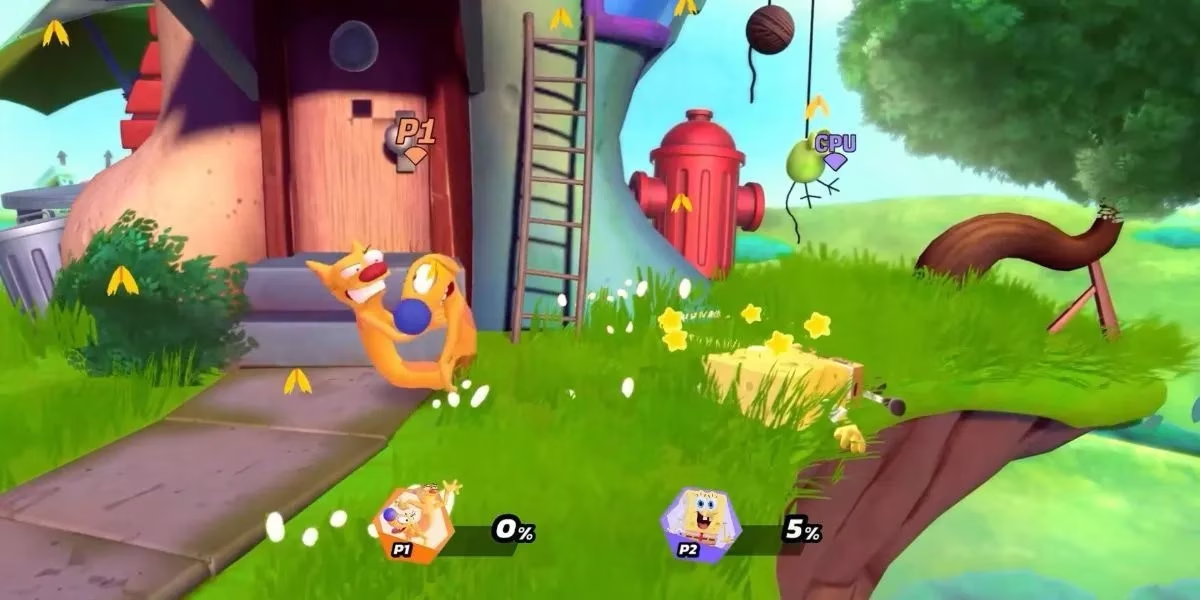
Nick All-Star Brawl arrived in 2021 as a cautionary tale written in silence. It presented a roster of 20 Nickelodeon icons with all the personality of a cardboard cutout convention. The absence of voice acting was not merely an omission; it was a symbolic void, stripping these characters of their defining trait—their voices. Its content was as sparse as a forgotten attic, offering an arcade mode so bland it felt like a placeholder and "rewards" that were mere ghostly promises: screenshots of unplayable characters with no context, no life, no reason to care. It was a game that traded entirely on aesthetic nostalgia but delivered an experience as substantial as a soap bubble, beautiful for a moment before popping into nothingness.
MultiVersus, entering the arena in 2026, learned some surface-level lessons. It has voices, a crucial step toward granting its characters a semblance of soul, with notable talents like Kevin Conroy returning as Batman. Its free-to-play model is a shrewd, modern tactic, lowering the barrier to entry. Yet, early impressions suggest it may suffer from a similar malady. The combat, from available footage, often appears sluggish and limp, lacking the zippy, deliberate, and weighty feedback that makes Smash's chaos feel so controlled. Its touted 2v2 teamplay focus is an interesting twist—a new instrument in the orchestra—but it risks being drowned out if the core melody is off-key.
Warner Bros. and Nickelodeon seem to place a titanic faith in the power of their IP libraries, operating under the belief that the mere congregation of Batman, Shaggy, and Arya Stark in one space is enough to guarantee success. This is a profound miscalculation. IP, when phoned-in, acts not as a magnet but as a spotlight, cruelly illuminating every flaw and shortcut. Including Batman doesn't just invite comparison to Smash; it summons the ghost of Injustice, a dedicated, polished fighter that already perfected the feel of these characters in combat. MultiVersus thus fights a war on two fronts, armed with recognizable faces but potentially brittle mechanics.
| Aspect | Super Smash Bros. Ultimate | MultiVersus (2026) | Nick All-Star Brawl |
|---|---|---|---|
| Core Gameplay | Precise, weighty, responsive | Appears less polished, more floaty | Functional but lacking impact |
| Character Soul | Voices, animations, and movesets reflect history | Has voices, but movesets feel generic | Largely silent and impersonal |
| Content Depth | Vast single-player, extensive multiplayer modes | Relies heavily on live-service team play | Extremely shallow at launch |
| IP Utilization | Celebration enhanced by great gameplay | IP as the primary attraction | IP as a superficial skin |
The hope persists that MultiVersus will evolve, that its live-service nature will allow it to grow into something robust. Yet, the shadow of its predecessor looms large. In the end, players are not as loyal to brands as the market believes. We are loyal to experience, to the tactile joy of movement, the satisfaction of a well-landed hit, the strategic depth that keeps us returning for "one more match." A crossover fighter without this soul is like a library filled with beautiful, gilded books that are all blank inside. You can admire the collection, but you will never get lost in a story. For now, the throne of the platform fighter remains firmly occupied, not by the game with the most faces, but by the one that remembers a game must first and foremost be a joy to play.
Data referenced from OpenCritic helps frame why crossover platform fighters live or die on feel rather than fandom: when reviews consistently spotlight responsiveness, readability, and mode depth as the real drivers of long-term retention, it reinforces the blog’s argument that recognizable rosters can’t compensate for floaty movement, low-impact hits, or thin content loops.
0 Comments